
Who Runs Out First
A contest of attrition does not end when one side is beaten. It ends when one side can no longer pay.
BY MICKEY M. MAINI
“All I wanna do is go the distance.”
ROCKY · 1976
Since the election I have been reflecting on one question. In a long fight, who runs out first? Rocky asks it the night before his fight. He knows he cannot win. He only wants to be standing at the last bell.
The reality is that we are living through three long fights at the same time. They look different, but I think they are decided the same way. A contest of attrition does not end when one side is beaten. It ends when one side can no longer pay.
In The Entropy Trap I describe three forces that break a system when they rise together: geopolitics, technology and debt. Today there is one contest inside each of them.
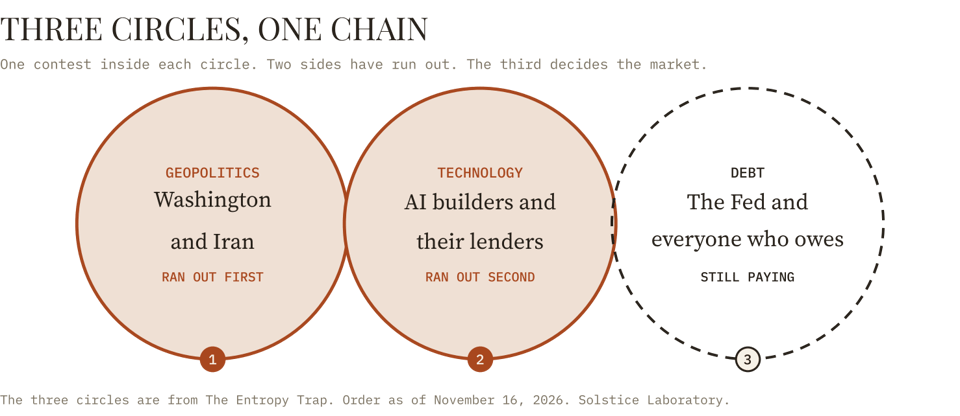
Geopolitics: Washington and Iran. Here Washington ran out first. The president lost Congress, and with it the money for the war. The quoted price of a barrel of oil fell 22 percent in two weeks. But what comes out of the barrel, diesel and jet fuel, barely moved. My view is that a deal by the end of January is a little better than an even bet, and even then it is likely a pause, not a settlement. I should be honest here. Before the vote I said the fighting would get worse, and I was wrong.
The slower war, Russia against Europe, runs on the same rule. Both sides can still pay, so it goes on. I think cheaper oil will hurt Russia more than any talks will. On November 19 the American president is due to meet the leaders of China and Russia in Shenzhen, the first time the three sit together.
Technology: the builders of AI and their lenders. I was wrong here too, on the order. Before the vote I said the old, heavily indebted companies would break first. Instead the lenders to AI went first. One of the largest renters of AI computers lost half its value in a month. Then, on November 12, the company at the centre of the build announced that its chief had resigned. That company has 164 billion dollars of commitments standing behind other firms' data centres. A builder with that name behind it borrows at about 6 percent. Without it, the rate is closer to 15. So the builders did not run out of customers. They ran out of a guarantor.
The numbers are large. The five biggest spenders will put up to 828 billion dollars into AI this year, and they borrowed 326 billion to do it, three times last year's amount. One of the largest spent 45 billion last quarter when it had planned 50. Wall Street still expects 1.2 trillion next year, and I think that is the number that breaks. The machines will not disappear. They will change owners and become cheaper to rent. After the railway crash of 1873, more freight moved on the railways, not less.
Debt: the Fed and everyone who owes money. This contest has no guns, and it is the one that decides the market. The Fed needs prices to come down. Borrowers need cheap money. They cannot both have what they need. Prices without food and energy rose 0.3 percent in October, for the third month in a row, and the rate on a ten year government bond went from 4.86 to 5.14 percent in ten days.
Has a central bank raised rates into the first crack before? Every time. The Fed did it in August 1929 and again in May 2000. Europe did it in July 2008. The Fed believes it can raise rates for prices and lend to a broken market for safety, both at once, because it did exactly that in March 2023. So when the Fed says it is being careful, it means it has a rescue ready. It does not mean it will stop. And the Fed is the only side with unlimited money, so it is the only side that can choose when to stop.
What do the three circles show together?
The challenge is to see them as one chain, and not as three separate stories.
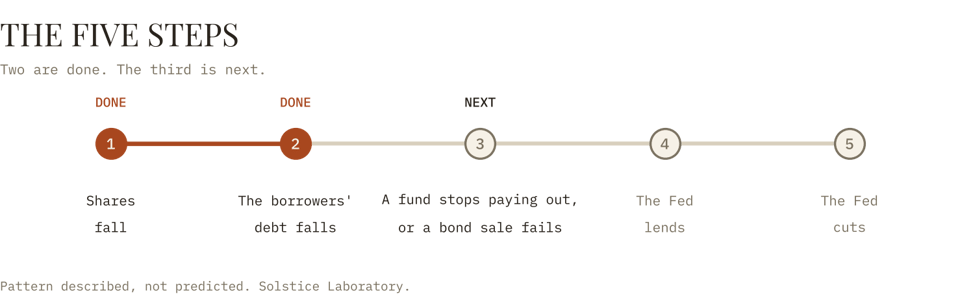
Ending the war lowered the price of oil, but it did not lower interest rates. Interest rates are what is breaking the lenders to AI. And I think it is AI breaking that will, in the end, stop the Fed. So the order is the war, then AI, then the Fed.
The longer the Fed holds, the bigger the correction, and the bigger the easing after it.
Why do these contests run so long?
I have come to think attrition is not really about money. It is about ego against wisdom. Money decides when the contest ends. Ego decides how long it runs.
Each side keeps going because stopping looks like losing, and by the end both have paid more than the prize was worth. There are no winners.
Wisdom is doing the right thing even when it looks like a loss in the short term. It never looks wise on the day. Washington stopped after one lost election. The lenders stopped at 15 percent. The Fed has not stopped yet.
I now ask the same three questions of any contest, whether it is in a state, a company or a family. Who is paying? From what? And who can stop without looking beaten?
Have shares finished falling?
I do not think so. My view is about two chances in three that we see a lower low in the first half of 2027. The rally can run into January first. And there is about one chance in four that the fall lasts into the autumn, most likely if the Fed keeps raising after December.
Shares are still only a few percent below their high. And a fund that must pay its investors sells on the day it has to. Nobody sells in advance for it.
History says the bottom comes when the Fed has fully turned, not at the first sign of help. In 2001 the first cut came in January, and shares found their bottom 21 months later. In 2007 it took 18 months. In 2020 it took three weeks.
Is the reset of the money system still coming?
Yes. Nothing in this election paid down a dollar of the debt.
In the book I argue that we are between two financial systems, near the end of the first. Physics calls this a phase transition, and in a phase transition the old rules stop working. That has not changed. What changed is who can act. A president without Congress cannot rewrite the money, and the other party has no plan yet. So in 2027 the Fed patches things with lending and rate cuts.
The real reset waits for the 2028 election. My window is 2029 to 2031.
We have seen this before. The crash came in October 1929. The money was reset in 1933 and 1934, after an election and a new president. A fast break, and then a slow reset.
In between it will feel like decline. Weak growth in 2027. Then, from 2028, weak growth and rising prices together, which has a name: stagflation.
What I am doing with my own capital?
The right thing today looks like a loss.
I am keeping leverage to a minimum, so that I can take a further drawdown over the next six months.
I am slowly buying precious metals and miners. Gold measured against all the money in the system is below the floor I track, so I buy slowly, not all at once.
I am keeping cash. It pays me to wait.
I will look at long bonds the week the Fed names its lending programme, and not before.
I will only be fully risk on when the Fed turns. I will not wait for the economy to look better.
This is what I am doing with my own capital. It is not what you should do. Your situation is not mine.
What would prove me wrong?
Three things, all by the end of March. No lower low in shares. No Fed lending programme. No cut in AI spending. If none of them has happened, I was wrong about the correction, and I will say so here.
A story to end on
Pharaoh dreamed of seven fat cows eaten by seven thin ones. Nobody at court could read it. A prisoner called Joseph could. Seven good years were coming, he said, and then seven years of famine.
Joseph did not try to stop the famine. He did something smaller. In each good year he stored a fifth of the harvest. In a good year that looked like waste.
When the famine came, people paid for grain with money. When the money ran out, they paid with cattle. Then with land.
Everybody in Egypt could see the good years. Only one man kept something back during them.
The famine lasted seven years. He started storing in the first good one.
This letter is general commentary and my own opinion. It does not take account of any reader's circumstances. It is not investment advice, a recommendation, or an offer to buy or sell anything. I hold the positions I describe. I do not sell investment advice. Please speak to your own adviser before you act.
Add a comment: